
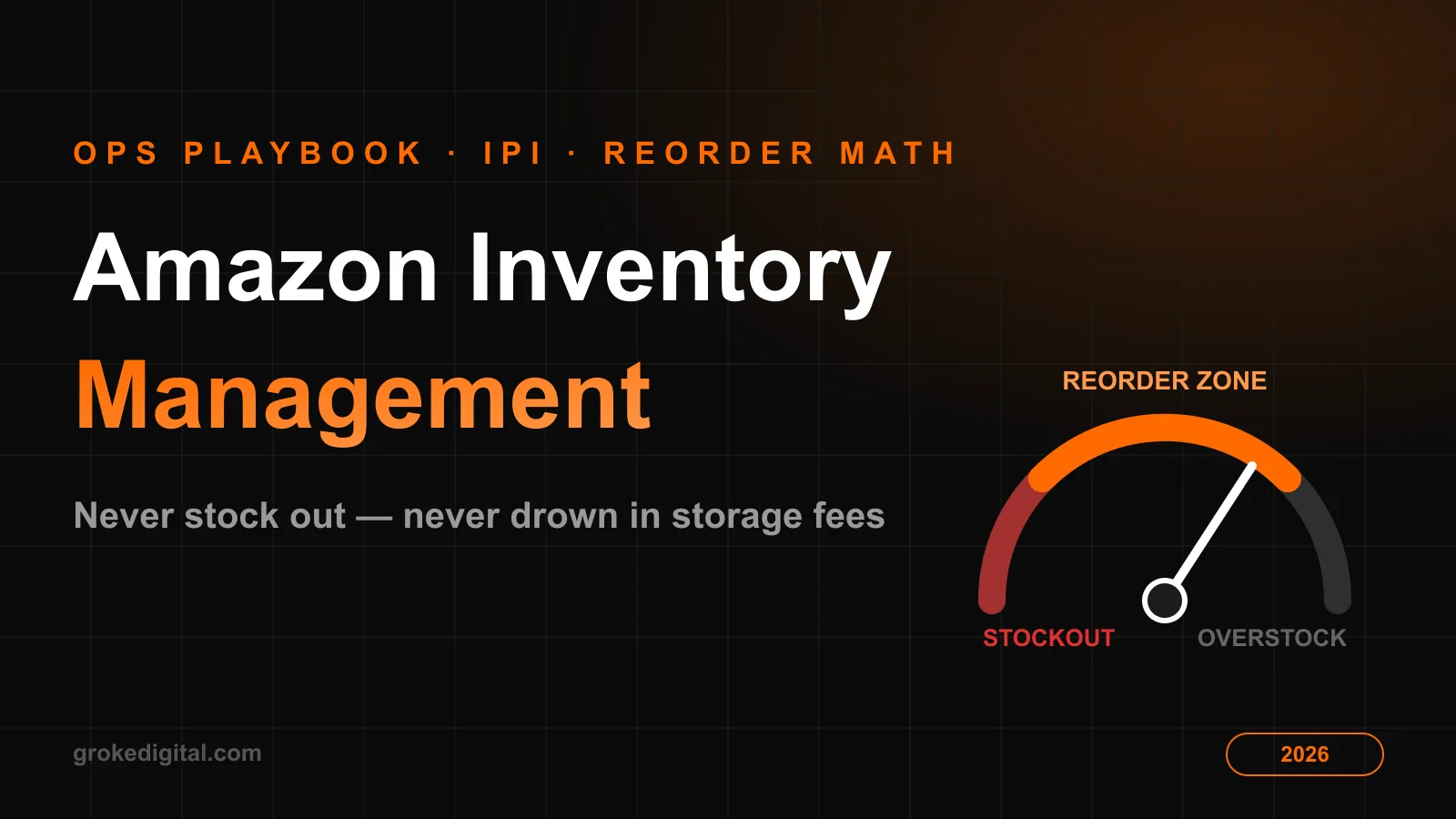
Good Amazon inventory management is invisible — products stay in stock, fees stay low, and nobody thinks about it. Bad inventory management shows up twice on your P&L: once as missed sales during stockouts, and again as storage fees on the overcorrection order. Here's the system that keeps you off that seesaw in 2026.
What Poor Inventory Control Actually Costs
- Stockouts: lost sales are the visible cost; the invisible one is rank decay — the algorithm reallocates your position to in-stock competitors, and recovering it means paying for the same rank twice
- Overstock: monthly storage fees, aged-inventory surcharges that escalate sharply after 180+ days, and capital frozen in slow movers
- Emergency responses: air freight to cover a gap typically costs 3–5x sea freight — a self-inflicted margin cut
The Reorder Point: Three Numbers That Run Everything
Reorder point = (daily sales velocity × total lead time in days) + safety stock.
- Velocity: use a 30-day average, weighted for trend and season — last year's Q4 curve matters more than last month in autumn
- Lead time: count everything — production, freight, customs, and Amazon's receiving delay (which stretches badly in Q4)
- Safety stock: 2–4 weeks of velocity for stable products; more for long lead times or volatile demand
When stock touches the reorder point, you order — not when it “feels low.” This single habit prevents most stockouts we see in audited accounts, and stockouts feature heavily in our ten costliest seller mistakes.
Q4 warning: velocity can triple while lead times stretch — recalculate reorder points in September, not November. The full peak-season timeline is in our Q4 strategy guide.
IPI Score and Capacity Limits
Your Inventory Performance Index (IPI) is Amazon grading how well you balance stock — excess inventory, sell-through, stranded inventory and in-stock rate. It matters because it drives your FBA capacity limits: strong scores earn room to grow, weak scores literally cap how much you can ship in.
- Keep sell-through healthy: aim to turn inventory every 60–90 days
- Fix stranded inventory weekly — it's pure dead weight against your score
- Clear excess with coupons or Outlet deals before aged surcharges bite
- Protect in-stock rate on your best sellers above all else
Storage Fee Traps to Avoid
Monthly storage fees roughly triple in Q4, and aged-inventory surcharges compound the longer stock sits. The traps: shipping a year of inventory to “save” on freight, oversize products whose storage math never worked, and letting a failed product sit instead of liquidating it. Every fee line is detailed in the 2026 fee breakdown — model storage into unit economics before ordering, not after.
The Weekly 20-Minute System
- Check days-of-stock on every active ASIN against its reorder point
- Review inbound shipments for receiving delays
- Clear stranded and fix any suppressed listings
- Flag anything under 30 days of stock for action, anything over 120 for clearance planning
Twenty minutes weekly beats a crisis quarterly. If you'd rather never think about it, inventory planning is part of our full account management for US and Canadian brands.
Frequently Asked Questions
How much inventory should I send to Amazon FBA?
Enough to cover total lead time plus 2–4 weeks of safety stock at current velocity — typically 60–90 days of supply. More ties up capital and risks aged-inventory surcharges; less risks stockouts and rank loss.
What is a good IPI score in 2026?
Stay comfortably above Amazon's published threshold (historically around 400–500). Scores well above it earn generous capacity limits; scores near the line restrict how much you can ship in — exactly when you need flexibility most.
What should I do with inventory that isn't selling?
Act before aged surcharges escalate: run coupons or deals, try Amazon Outlet, create removal orders to a 3PL, or liquidate. Holding dead stock “until it sells” is usually the most expensive option on the list.
Stop losing rank to stockouts
Free ops audit — we'll calculate reorder points for your catalog and flag every storage-fee leak. 24 business-hour turnaround.
Get Ops Audit →