
The core difference nobody explains properly
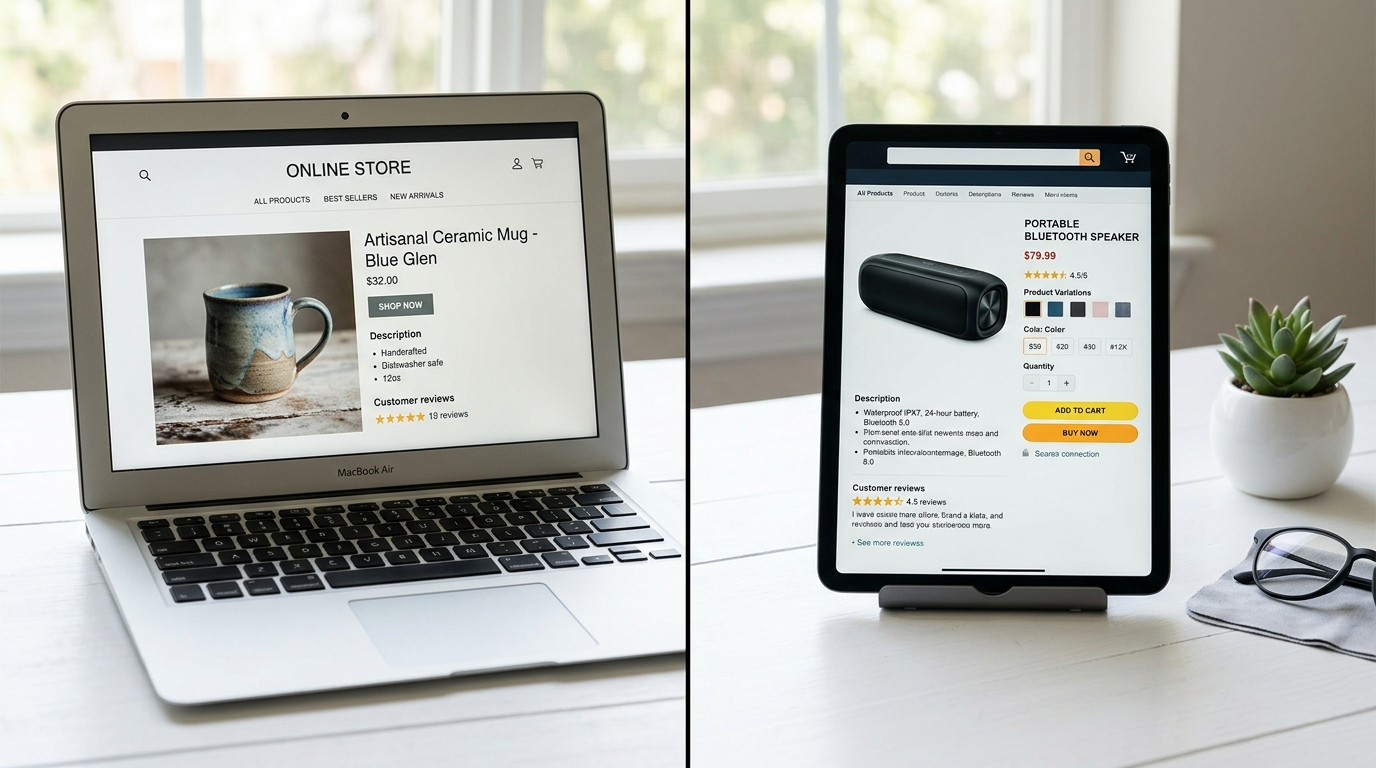
Most Shopify vs Amazon comparisons treat this as a feature checklist. They are not the same type of question. They represent two completely different business strategies:
- You sell on someone else's platform
- Traffic is already there — shoppers arrive ready to buy
- You rent shelf space in the world's biggest store
- Amazon owns the customer relationship
- Immediate sales potential from day one
- You compete with every seller in your category
- You build your own store and brand
- You must drive every visitor yourself
- You own the customer data and relationship
- Full control over branding, pricing and experience
- Slower to grow — requires marketing investment
- You compete with the entire internet for attention
Neither is inherently better. They serve different stages of a brand's growth and different types of sellers. The right answer depends entirely on your product, your budget, your timeline, and what you are ultimately trying to build.
What changed in 2026
Two shifts matter most this year: Amazon is expanding discovery beyond standard catalog listings (including Shop Direct and Buy for Me flows), and fee pressure is forcing brands to be stricter about channel mix and margin discipline. For most teams, Amazon still wins speed-to-revenue while Shopify remains the long-term ownership channel.
The question is not "Shopify or Amazon?" — it is "what am I trying to build?" A quick-cash product business has a different answer than a long-term consumer brand. Get clear on your goal before choosing your platform.
Fees comparison: what you actually pay on each platform
This is where most sellers get confused — the fee structures are so different that direct comparison is misleading. Amazon takes a cut of every sale. Shopify charges a flat subscription regardless of whether you sell anything.
| Fee type | Amazon | Shopify | Advantage |
|---|---|---|---|
| Monthly subscription | $0.99 per item sold (Individual) or $39.99/month (Professional) | Monthly plan fee that rises by plan tier | Depends on volume |
| Per-sale commission | Category referral fee (15% in most categories) | 0% (none) | Shopify wins |
| Payment processing | Included in referral fee | Card processing fees, plus 0.2–2% by plan if you use a third-party payment provider instead of Shopify Payments | Amazon wins |
| Fulfilment (FBA / 3PL) | Per-unit FBA fee set by size tier and weight | Self-ship or a 3PL’s quoted per-unit rate | Similar at scale |
| Storage fees | Charged per cubic foot per month, higher October–December | None (your warehouse / 3PL) | Shopify wins |
| Advertising (mandatory) | PPC near-essential to rank | Optional — SEO viable long-term | Shopify wins |
| Returns processing | Included in FBA | Self-managed cost and effort | Amazon wins |
| Customer acquisition | Built in (Amazon's budget) | 100% your cost (ads, SEO, social) | Amazon wins heavily |
Sources: Amazon selling plans and fees and Shopify pricing, checked September 2026. Both change regularly — confirm current rates before you decide.
Illustrative example (not client data): a product selling at $30 with a 35% gross margin has $10.50 before marketplace costs. On Amazon, a 15% referral fee ($4.50) plus an FBA fee of around $4.50 leaves roughly $1.50 before PPC. On Shopify, the same product shipped by a 3PL might keep $4–6 before advertising — but only if your advertising is efficient and your store converts well. Amazon is more expensive per sale but cheaper to start. Shopify is cheaper per sale but expensive to drive traffic.
Use this rule: if your Amazon referral fee plus FBA costs per order exceed your Shopify plan and payment costs plus your average customer acquisition cost per order, Shopify is cheaper. In our experience, newer sellers usually underestimate Shopify acquisition cost, which is why Amazon often works out cheaper in total at the start.
Traffic & discoverability — Amazon's biggest advantage
This is the most underrated factor in the entire comparison. Amazon is a product search engine in its own right. Many shoppers skip Google entirely and search Amazon directly when they are ready to buy.
When you list a product on Amazon, you are immediately visible to Amazon’s existing shoppers, many of whom already have payment details saved and a Prime membership. The intent is purchase-ready. These are not browsers — these are buyers.
| Platform | Conversion rate (relative, indicative) | Traffic source | Time to first sale |
|---|---|---|---|
| Amazon | Typically highest | Amazon’s existing shoppers | Days (with PPC) |
| Shopify (established store) | Moderate | SEO, paid ads, social, email | Weeks to months |
| Shopify (new store, no audience) | Lowest | Paid ads almost exclusively | 1–3 months minimum |
Conversion rates vary widely by category, price and listing quality, so we do not quote a single benchmark. The pattern we see is consistent, though: shoppers on Amazon arrive with purchase intent, so a new Shopify store usually needs several times more visitors to make the same number of sales. That traffic costs money or takes years of SEO to build, which is why conversion work on a Shopify store tends to pay back faster than more traffic does. Amazon's built-in audience is its most valuable and most underpriced feature.
Most new Shopify sellers dramatically underestimate customer acquisition costs. Paid social and Google Shopping are competitive auctions, and building organic SEO traffic to a new Shopify store usually takes many months. Budget for this or your Shopify store will be unprofitable.
Brand control — Shopify's decisive advantage
On Amazon, you do not own the customer. Amazon does. You cannot email your buyers. You cannot retarget them. You cannot build a loyalty programme. You cannot control the unboxing experience (FBA). When a customer buys from you on Amazon, they think of it as "buying from Amazon" — not buying from your brand. Amazon can change its algorithm, increase its fees, suspend your account, or launch a competing product tomorrow. You have no say.
- Email or market to buyers post-purchase
- See full customer data (name, address, email blocked)
- Control the packaging or unboxing (FBA)
- Run your own promotions independently
- Prevent Amazon competing in your category
- Build retargeting audiences from buyers
- Own every customer's email address
- Build email and SMS marketing sequences
- Control packaging and brand experience entirely
- Run any promotion, bundle, or loyalty scheme
- Build retargeting audiences and lookalikes
- Create subscriptions and recurring revenue
For brand building, Shopify wins decisively. A customer’s email address captured via Shopify lets you market to them again and earn repeat purchases. Amazon gives you the sale but keeps the relationship.
Fulfilment — FBA vs the alternatives
Amazon's FBA (Fulfilment by Amazon) is genuinely world-class infrastructure. Fast Prime delivery from Amazon’s fulfilment network, returns handled automatically, customer service included. For a small seller with no warehouse, FBA is transformative. For a large seller with tight margins, FBA's fees (which we covered in detail in our Amazon FBA Fees 2026 guide) significantly erode profitability.
| Option | Cost | Delivery speed | Best for |
|---|---|---|---|
| Amazon FBA | Per-unit fee by size tier and weight | Prime-eligible fast delivery | Amazon sellers, high volume, light/small products |
| Amazon FBM (self-ship) | Your cost + carrier | 3–7 days typical | Heavy/bulky, custom, or low-velocity items |
| Shopify + 3PL | Quoted per unit by the 3PL | 2–5 days | Shopify stores, multi-channel brands |
| Shopify + in-house | Labour + packaging cost | You control | Low volume, premium unboxing, custom products |
| Multi-channel (FBA for both) | FBA rates + MCF fee | 2–5 days for non-Amazon | Brands scaling both channels simultaneously |
Amazon's Multi-Channel Fulfilment (MCF) allows you to fulfil Shopify orders from your FBA inventory — one warehouse powering both channels. The per-unit cost is slightly higher than standard FBA, but the operational simplicity for growing brands is significant.
Competition risk — the honest conversation
Amazon is the most competitive retail environment on earth. Your listing sits next to every competitor in your category, including Amazon's own private label brands. Amazon has access to your sales data and has used it historically to identify successful categories and launch competing products under its own labels (Amazon Basics, Amazon Essentials, etc.).
On Shopify, you own your store and there is no direct competitor sitting next to your product. However, you still compete with every other website online for the same Google keywords and the same paid advertising audiences. The competition is different in nature but equally real.
The Amazon risk is concentration. Sellers who build 100% of their revenue on Amazon have no negotiating leverage with the platform. When fees go up (and they do, every year), their margins shrink. When accounts get suspended (and it happens), their entire business stops. Diversification via Shopify is not just a growth strategy — it is a risk management strategy.
Profitability — which makes more money in 2026?
Neither platform is universally more profitable. It depends on your product, your category, your marketing skill, and your stage of growth. Here is how profitability actually plays out across the brand lifecycle:
| Stage | Amazon profitability | Shopify profitability | Recommendation |
|---|---|---|---|
| 0–6 months (launch) | Possible but thin (high PPC spend) | Likely negative (building traffic) | Start Amazon |
| 6–18 months (growth) | Improving as organic rank builds | Breaking even as SEO kicks in | Amazon primary |
| 18–36 months (scaling) | Profitable but fee-pressured | High margins on repeat customers | Both channels |
| 3+ years (established brand) | Reliable volume, thinner margins | High-margin owned audience revenue | Shopify grows in importance |
Which platform is right for you? The decision framework
Stop reading general comparisons and answer these specific questions about your business:
The answer most successful brands arrive at: sell on both
The real insight from our work with ecommerce brands across both platforms is that the question is not "which platform?" — it is "in what order, and at what ratio?"
The most successful brand growth strategy in 2026 runs like this:
- Start on Amazon — use its built-in traffic to validate your product, generate revenue, accumulate reviews, and fund the business in years 1–2.
- Launch Shopify in year 2 — once you have proof of product-market fit and cash flow from Amazon, build your owned channel. Drive traffic from brand awareness you've built on Amazon.
- Use Amazon traffic to build Shopify — insert package inserts with QR codes to your Shopify store. Offer subscribe-and-save discounts for Shopify customers. Funnel repeat buyers off-Amazon.
- Scale both in parallel — Amazon for volume and new customer acquisition. Shopify for margin, customer lifetime value, and brand equity.
If you ever plan to sell your brand, buyers tend to view brands with revenue on both Amazon and Shopify as lower risk. Amazon-only brands carry platform risk. Shopify-only brands carry traffic risk. In our view, a brand with a healthy split across both channels is more attractive than a single-channel brand of the same total revenue.
The bottom line: Start where the customers already are — Amazon. Build your brand where you own the relationship — Shopify. Neither platform is your enemy. Your competitors are. Use every tool available to beat them.
Ready to build on Amazon, Shopify, or both?
We manage Amazon and Shopify for ecommerce brands — from launch strategy to full-channel scaling. Tell us where you are and we'll build the right plan.
Book a Free Strategy Call →